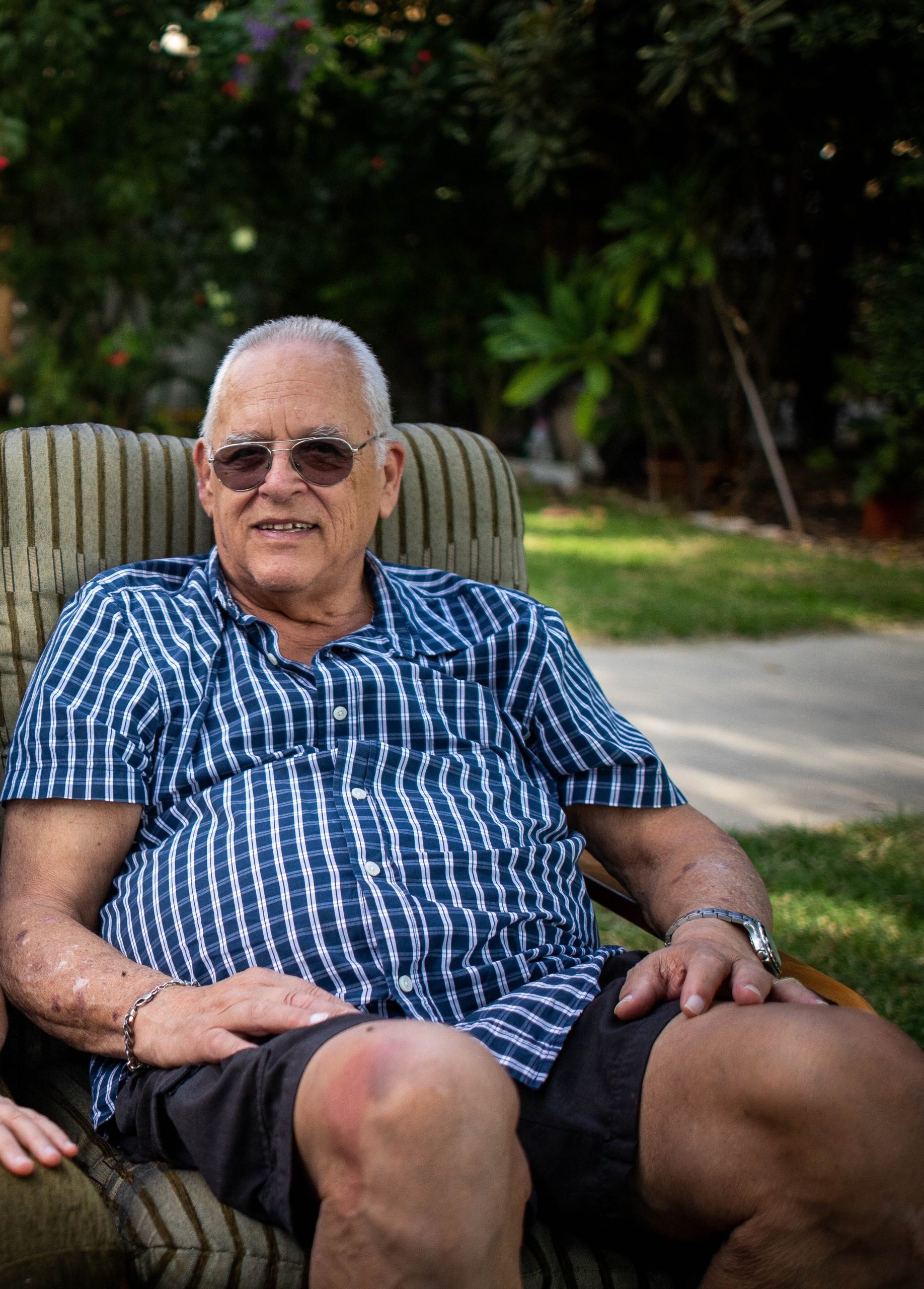


Here Lived
Moshe Zilberman came to Nir Oz as part of a youth group from Kibbutz Ein HaShofet. Ein HaShofet adopted the young kibbutz (Nir Oz) and sent its sons and daughters to settle it. Moshe lived alone in this house since his divorce in 2007. It was an old house that once housed young families with children. Throughout the years, even the kitchen was never renovated, and it still boasted green Formica with wooden handles, as was the trend in the 1970’s. Over the years, various works of art made by Moshe decorated the walls of the house. These works of art were made from various materials – sculptures, carvings, metalwork, welding, and more. So many works of art filled these walls that no empty space remained between them.
Moshe was 76 years old. In recent decades, he repaired bicycles. In the year prior to the massacre, Emilyn joined him. She arrived from the Philippines to assist Moshe at his advanced age.
October 7th
On the day of the massacre, the two were in the safe room for many hours. Terrified, they didn’t hold the doorknob, choosing instead to embrace each other until they were rescued by the army in the evening. Although his home was attached to his neighbors’ house, who were kidnapped, the terrorists didn’t enter Moshe’s home. Instead, they stole his mobility scooter and the tools that were outside the house.
What Happened Since
Moshe z”l died on April 23, 2025, due to severe mental and physical deterioration, resulting from the trauma of that day’s events. These events intensified following his stay at the evacuees’ hotel in Eilat, where he lived as a displaced resident with Emilyn and the rest of the Nir Oz community. His subsequent attempt to settle in Karme Gat was unsuccessful, and as his mental condition further deteriorated, he spent most of his time receiving treatment at the Mental Health Center in Be’er Sheva. From time to time, he tried to live in a housing unit at the home of his youngest daughter, Yarden, in Kibbutz Dvir. The hope that Moshe and his family held regarding his chances of recovery from his psychological suffering gradually diminished as prospects for a deal that might secure the return of his friends, those who remained captive and continued to languish in the tunnels, grew ever more distant. Around that time, and before his death, his daughter Yarden wrote a song that was later composed and performed by Nurit Peled-Kirshtain, produced and instrumentally accompanied by Gal Dahan. The lyrics of the song sought to give voice to the anguish of those who survived physically, yet slowly faded under the burden of their psychological scars:
“Perhaps it seems as though nothing matters to him,
But he awaits those who are there, to return already
This man is father and grandfather and Moshe,
It is very difficult for this man since that horrible Shabbat
He suffers and can’t find a bit of relief
This man understands that he has nowhere to return
Before then he still stood on his feet
But that is of no interest to anyone there in Jerusalem
This man is still alive, but his soul has found its death
And he counts the days from his bed
This man is in captivity, but here, very close
This man is still captive from that same day in the safe room.”
The song wasn’t released to the radio when Yarden had hoped it would be released. It was first heard at Moshe’s funeral in Kibbutz Nir Oz and resonated deeply with those in attendance. It received many responses, reflecting how strongly members of the Nir-Oz community identified with its lyrics, which poignantly captured the reality of the older generation, who survived the massacre and the physical and psychological struggles they have faced ever since.