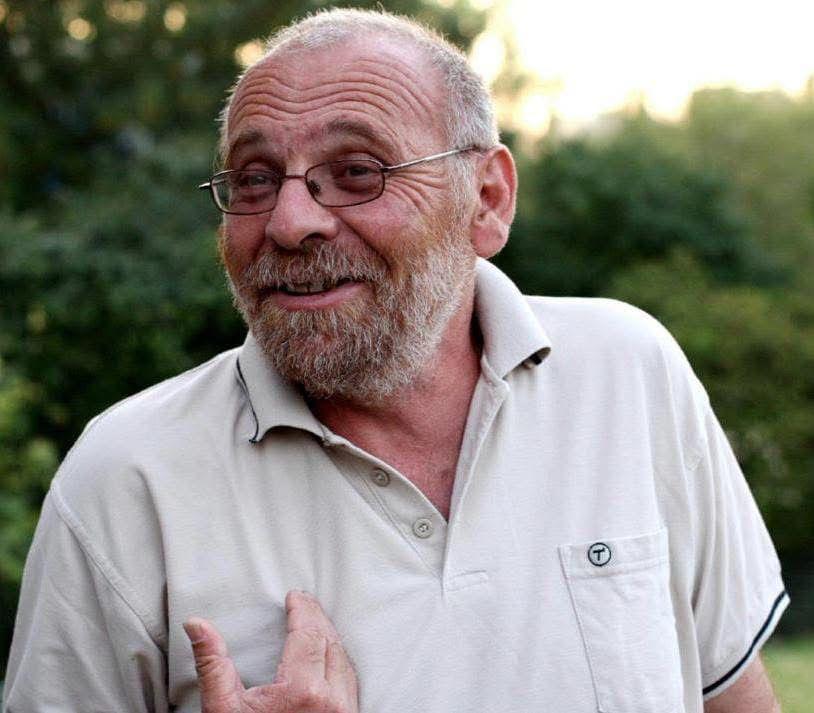


Alex Dancyg was born on July 21, 1948, in Warsaw, Poland, to his parents, Nina and Martin, and his sister, Edith — all of whom were Holocaust survivors. At the age of nine, he made aliyah to Israel with his family, and they lived in Tel Aviv.
In his teens, Alex joined the Hashomer Hatza’ir movement. In 1966, he enlisted in the Nahal Brigade and fought in the Six Day War. After completing his military service, he arrived in Nir Oz as part of Gar’in Miran, where he made his home and raised his family with his wife, Rachel.
Alex combined agricultural work and academic studies, education and research. He was a brilliant historian and educator who dedicated his life to preserving the memory of the Holocaust and to building bridges to strengthen relations between Israel and Poland.
He was the father of four children: Ben, Mati, Yuval and Lee. He was also the proud grandfather of 13 wonderful grandchildren.
On the morning of the Black Shabbat, Alex was abducted from his home in Nir Oz and taken to the Gaza Strip. Despite suffering from medical problems, Alex was held in Hamas captivity under harsh and merciless conditions. Nevertheless, fellow hostages who were held with him and later released attested to his extraordinary inner strength. Even in the depths of the tunnels, Alex remained an educator through and through, delivering lectures on history and philosophy to his fellow captives to keep their minds engaged and uplift their spirits.
For many long months, his fate was shrouded in uncertainty. On July 22, 2024, based on intelligence findings, the IDF announced that Alex had been murdered while in Hamas captivity in Khan Younis. About a month later, during a complex military operation, his body was recovered from Gaza, along with the bodies of his friends from Nir Oz: Abraham Munder, Yoram Metzger, Haim Peri, Nadav Popplewell and Yagev Buchshtav.
Alex was widely regarded as a role model who deeply believed in the power of dialogue. He was among the founders of youth delegations to Poland and trained thousands of guides and educators. For many, he was a “walking encyclopedia,” someone to whom any historical question could be posed and who would invariably provide a thoughtful, well-reasoned answer.
“Alex was a man of books and of the land,” his loved ones eulogized. “He knew how to weave the great tragedy of the Jewish people with optimism and a love of life on the kibbutz.” His legacy as an educator and researcher will continue to inspire generations of educators in Israel and around the world, who regard him as a symbol of the resilient human spirit that refused to surrender, even in the face of immense darkness.
He was 76 years old at the time of his death.
May Alex’s memory be a blessing.